
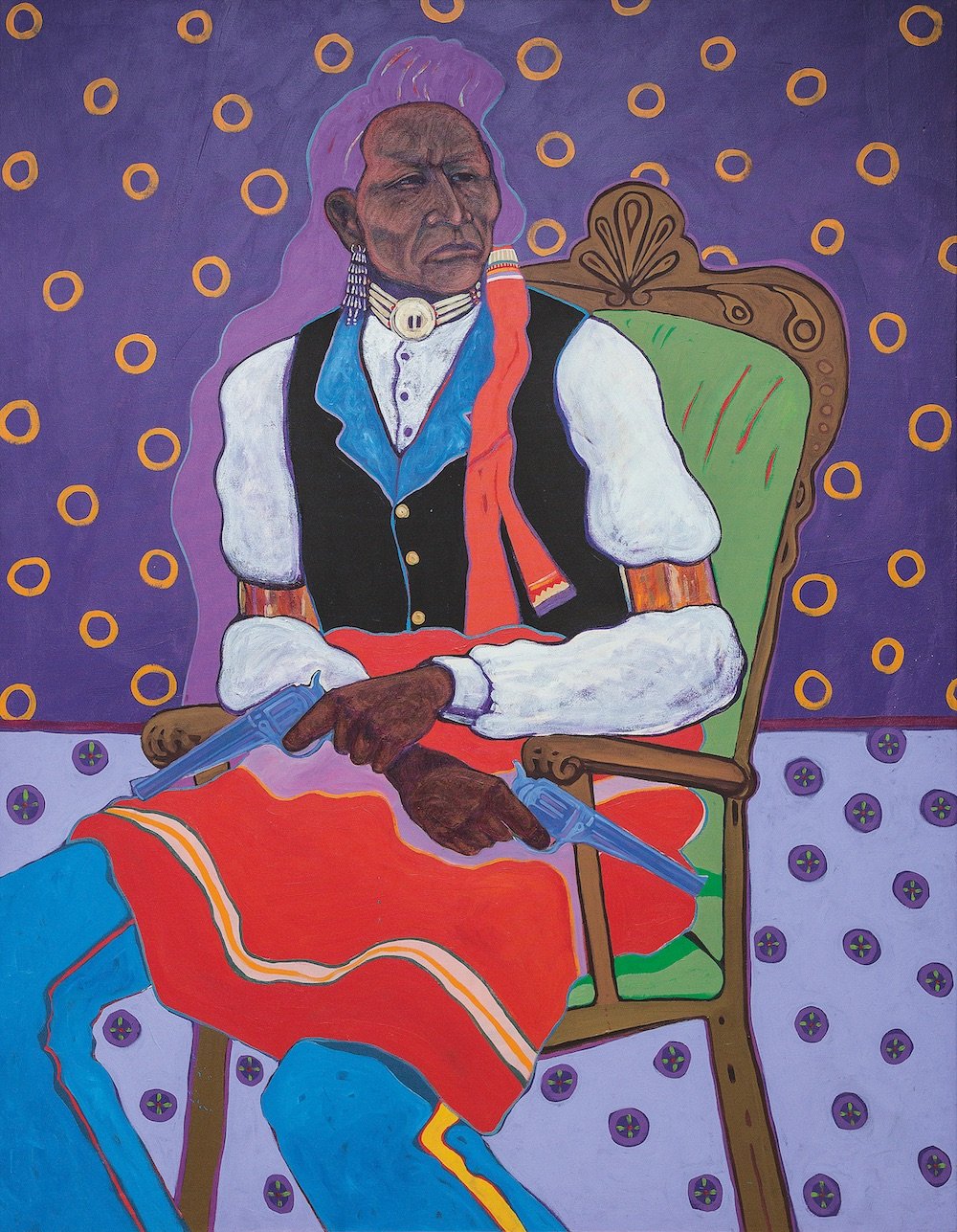
This excerpt is a part of the Not From Here blog series highlighting sections of undergraduate students’ research. IEHS recognizes the intellectual labor involved in undergraduate research and advising. We invite history majors who have written a senior honors thesis and/or participated in public history projects relevant to the IEHS mission to submit a blog post based on their research.
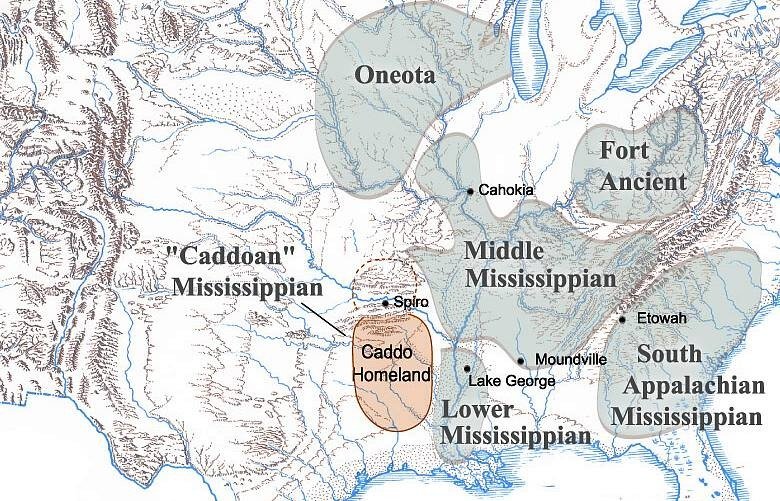
The Caddo’s collective experience offers a unique perspective on the history of North American colonization. The location of their historical homelands led to longstanding interactions with plantation slavery and escaped maroons, slaves who left their plantations to form their own communities on the outskirts of plantation geographies, and their communities, creating an additional dimension to this region as a borderland, and the ways that position led to disparate methods of resistance. Their position on the outskirts of the very northern reaches of New Spain also placed them on the periphery of that colonial geography, which led the Caddo to develop a diplomatic relationship with Spanish missions and settlers. According to one account written by Fray Isidro de Espinosa in the 18th century, the Native tribes in East Texas guarded each other’s privileges and rights, and they took the ideas of justice seriously. However, when ambassadors came in good faith they treated them, including those of the Spanish, with respect. When an ambassador arrived, they dressed in their finest clothing, bringing the most valuable gifts that they had from working the land, and would send their chieftains to receive these visitors. Europeans often regarded the Caddo with respect as well, not to mention the fact that they held significant control over the territory they resided in. It was not the case that the Caddo needed Europeans—rather, the Europeans needed the Caddo.
In the 18th century, the Caddo mostly welcomed and had good relations with the French. The French had claimed the Kadohadacho, just one of the many Caddoan tribes, as French subjects, while the Spanish claimed the Hasinai, another Caddoan tribe who inhabited central Eastern Texas.1 Unlike the Spanish, who went north to convert Native Americans to Christianity in the hopes that they would become loyal Spanish subjects, the French largely respected the Indigenous peoples they encountered and married into Indigenous communities. Looking at the marriage contracts in Natchitoches, Louisiana, there were at least two documented cases. The French held such significant influence over the region that they went so far as to begin trading with the Hasinai, undermining the Spanish claim to the region. This does not necessarily mean that it was the French who held the power in the region. Rather, the many tribes of the Caddoan confederacy often dictated who held legitimacy to the area.
The border region became incredibly tenuous after the French left, as the United States and Spanish competed to fill the power vacuum. Alliances were shaken up, and now it was the US vying for control in the region. By 1805, the Spanish had lost trade superiority to the US, forever turning the tide in the region. As this occurred, Edward D. Turner, the US commander at Natchitoches, received word on Spanish and Native American movements west of the Mississippi River. A Caddo Chief had requested an American flag to hoist in his village, at the same time that the Spanish were greatly increasing their military and settler presence in the frontier territory of Tejas. Multiple military units, including troops, cavalry, and infantry were being sent from Mexico City, while a thousand families were relocating from the populated regions of New Spain to the frontier. These movements made by the Spanish were a direct result of them losing favor with the Caddo in particular. Even into the 19th century, the Caddo still held significant sway in the politics of the region.
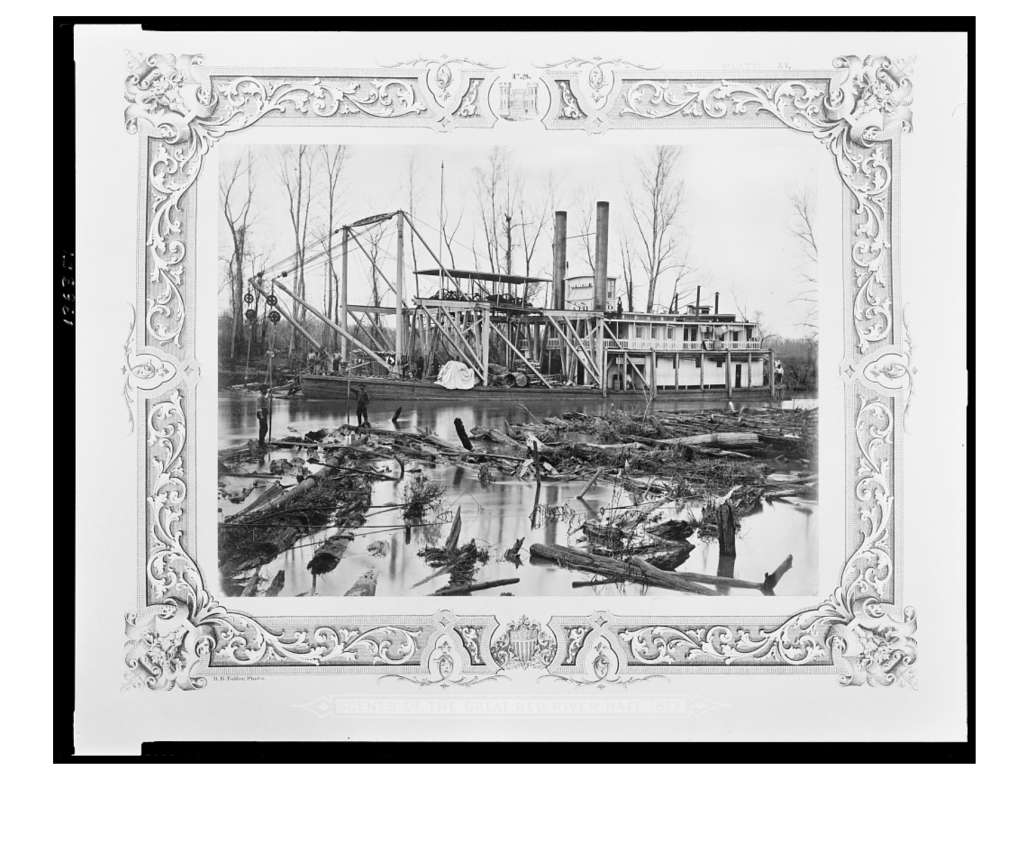
The Caddo were a people defined by their peripherality. Being on the edge of Mississippian society, they reaped the benefits of a large network of trade routes and cultural exchange, while their own social structure let them evade central collapse like the Middle Mississippian cultures suffered. Being on the outskirts of the French center of colonial power in New Orleans, they enjoyed access to European goods. Their status as intermediaries between the French and the Spanish meant that the Spanish were also always trying to gain their trust. However, their geographical location would also end up being their downfall. As the US expanded into the Mississippi Basin, slave holders and cotton planters came looking for land. For years, the land in which the Caddo resided was of little use to these systems of domination. The Great Raft was a centuries old log jam stretching from the modern city of Shreveport, Louisiana, to the Carolina Bluff, near the border of Texas, Louisiana and Arkansas. The safety this region provided eroded as Henry M. Shreve began systematically removing the land feature in the mid-1830s.
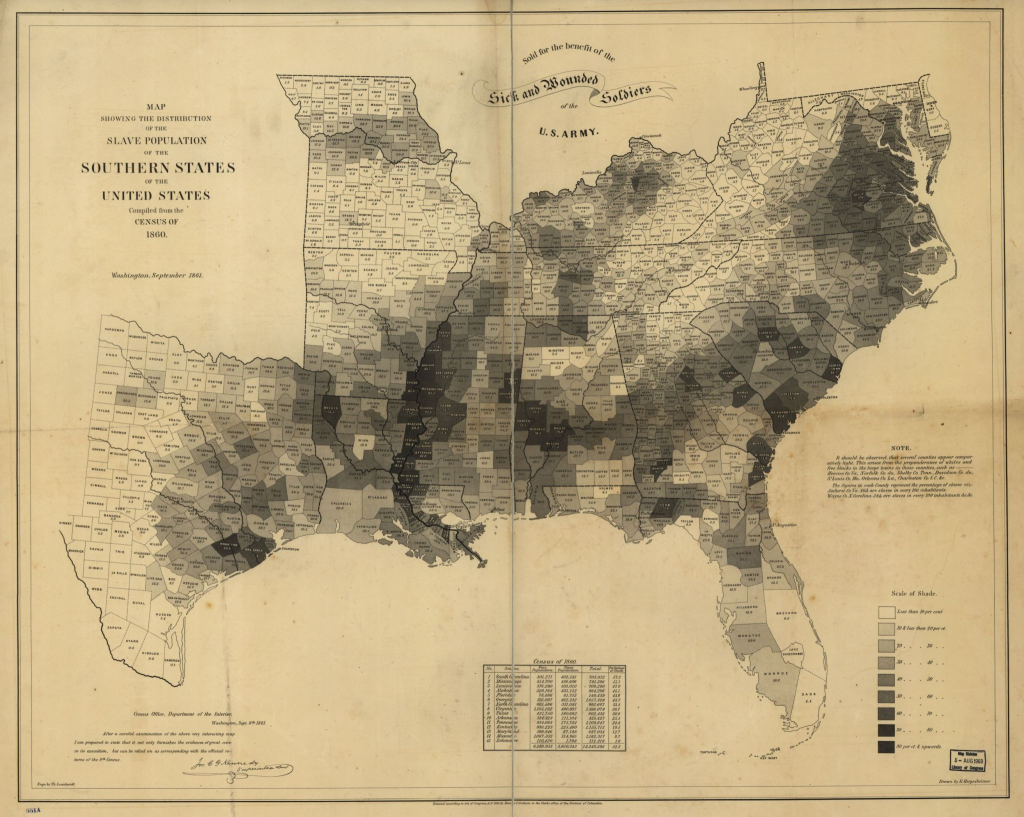
By the early 19th century, Americans began to conceive of the vast Louisiana territory as a place and home for the rugged, independent, white settler.2 A key component to the new ideas of settlement of the West was the whiteness of the settler population, a fact that was in direct contrast to the real makeup of the territory, especially in the northern provinces of New Spain and Mexico. Thousands of Native Americans, freed Africans, and Mexicans inhabited this vast region, and turning it “white” would require significant effort. The question of slavery also loomed over this territory, and it was primarily that ideal of whiteness that determined the racial makeup of the territory more than anything else. Settlers and government officials from the US both concerned themselves with both the free Black and enslaved population that would most likely migrate into these new territories, either escaping the slavery of the South, or being brought there by the thousands by the planters themselves.
The Missouri Compromise was the solution to this issue, and allowed for largely unencumbered mass white settlement into the territory, or as stipulated in the compromise, any piece of the Louisiana Purchase that extended north of the agreed-upon 36° 30’. However, after the Mexican-American War, the vast majority of the American West became part of the US, with Texas becoming an even more attractive destination for white immigrant settlers. With the addition of the Oregon Territory in 1848, settlers were now crossing the entire continent in search of land to settle on, rather than the next available tract in the Mississippi River Basin. In California and Oregon in particular, the debate of slavery and whiteness became significant. California had a deep history as a part of New Spain, and many Spaniards and Mexicans still called the region home. Oregon, on the other hand, had seen little to no European settlement until the 1840s, meaning the area was ripe for the development of a new particularly White settler ideology. What would develop in Oregon would inform how whiteness was legislated in many of the new territories, building on those ideas developed in the Midwest and South in response to Free Black migrants and Native Americans.
The fear of free laborers competing with slave labor led California to write into its constitution a ban on slavery, and not include African Americans in its requirements for suffrage. The constitution enfranchised all white males over twenty-one, as well as any white citizen of Mexico who would disavow their old citizenship in favor of the US. It also allowed for the suffrage of Native Americans.
This debate over suffrage in the Oregon Territory would be defined by one instance in 1844 between a freed Black man named James Saules and a Native American named Comstock that turned violent. Comstock was found dead, and the white settlers of the community blamed Saules for his death. In response, Saules, who had married an Indian woman, declared that he would turn local Native tribes against white settlers. This, to the white settlers, proved that African Americans would make alliances with Natives, and this posed an existential threat to lasting peace in the territory. While there was no basis for this idea outside of Saules’ threat, it was enough that the state constitution would go on to ban slavery within three years, and force any slaves emancipated in this process to leave within two, or face indentured servitude under a White man. To go further, the Oregon legislature passed a bill completely prohibiting freed Blacks from settling in the territory, citing the Comstock affair, to ensure “utmost harmony” through keeping the state as white as possible.
On the East Coast, new unified visions for what the West would look like were also forming. In 1848, New York Senator John Adams Dix laid out his specific vision for what the country would become. He thought it to be America’s mission to take the overcrowding of Europe and instruct them to “accelerate the march of civilization across the continent.”3 Furthermore, he argued that it was God who wanted them to settle the American West, and he would bring the US forward to become a powerful nation.
This creation of a standard of whiteness became central to the ideology of westward expansion. To Americans, it did not matter that the land was being worked, it would have to be worked by white settlers and white settlers alone. For the Caddo, their land was simply too attractive to be left to their cultivation. It would have to be worked by the slaves owned by the Southern planter class. Herein lies the difference between Spanish and American activities on the periphery. The pure extraction of resources, much like silver mining in New Spain, was not the goal of Anglo-American settlers, so Native American labor was not needed. Instead, settlers sought to stake a claim and make their lives on the land.
- Todd Smith, “The Kadohadacho Indians and the Louisiana-Texas Frontier, 1803-1815” https://www.jstor.org/stable/30237098 ↩︎
- Jason Pierce, “The Politics of Whitness and Western Expansion, 1848-80” http://www.jstor.org/stable/j.ctt19jcg63.11 ↩︎
- “State of Parties,” Congressional Globe, 30th Congress, Session I, Appendix, 865. ↩︎
